

Why We’re Opening Our Vault: The Security Transparency You Deserve
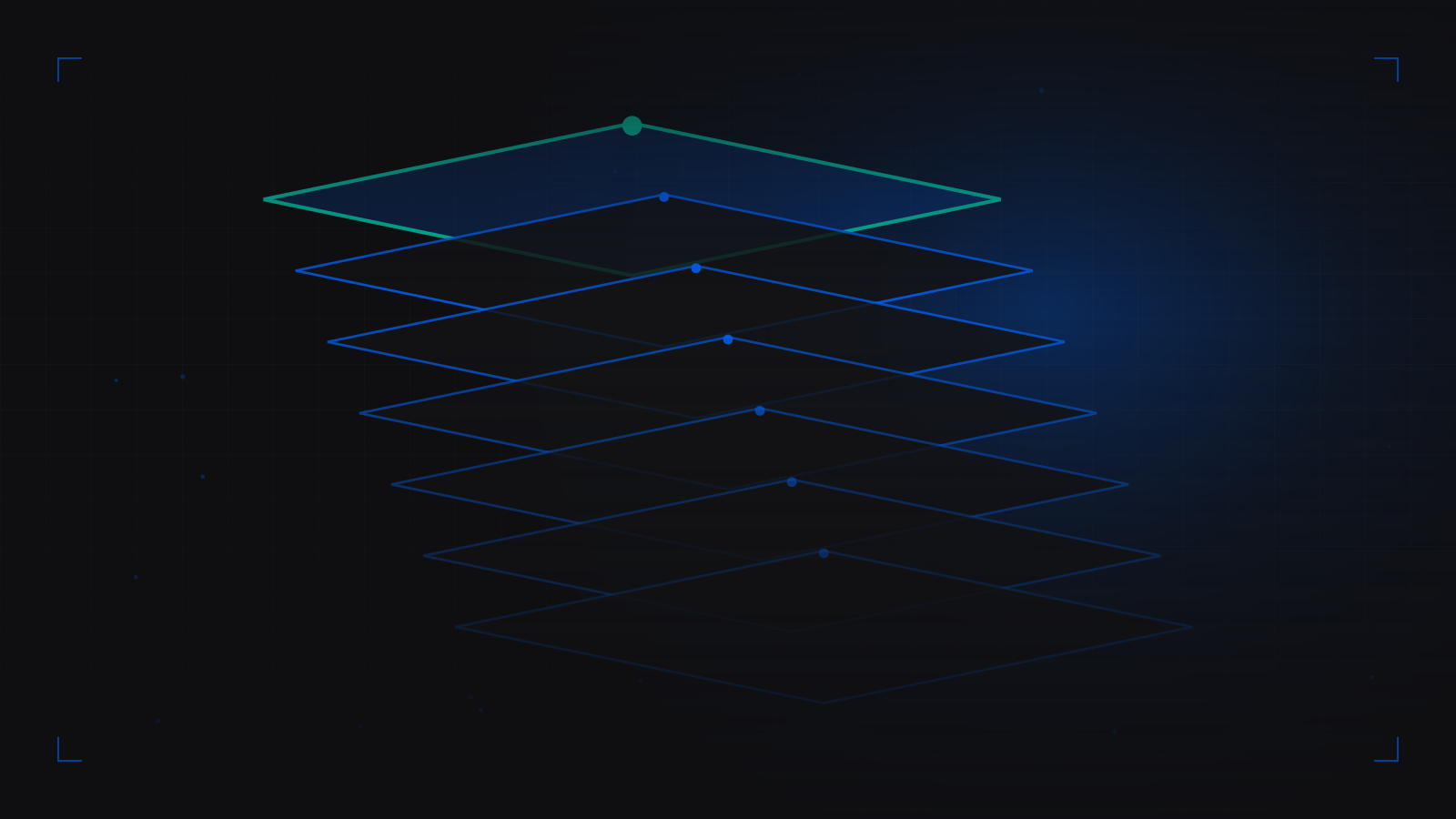
In DeFi, “trust us” isn’t good enough—and it never should be. After witnessing $3.1 billion stolen from DeFi protocols in 2022 alone, we built Shield Finance with one non-negotiable principle: **radical security transparency**. Today, we’re pulling back the curtain on our complete 7-layer security architecture, complete with code snippets, audit results, and real-time monitoring data. Because in an industry where your funds are only as safe as the smart contract holding them, you deserve to see exactly how we protect every dollar.
Layer 1: Smart Contract Architecture—Building on Battle-Tested Foundations
The Foundation Matters
Our smart contract architecture begins with a simple philosophy: don’t reinvent the wheel when it comes to security-critical components. We leverage OpenZeppelin’s audited contract libraries as our foundation, implementing proven patterns that have withstood years of adversarial scrutiny.
**Key Implementation Details:**
- **Access Control**: Role-based permissions using OpenZeppelin’s `AccessControl` contract
- **Pausability**: Emergency circuit breakers on all critical functions
- **Upgradeability**: UUPS proxy pattern with timelock governance (48-hour delay)
- **Reentrancy Guards**: Applied to every external call and state-changing function
“`solidity
contract ShieldVault is
Initializable,
AccessControlUpgradeable,
PausableUpgradeable,
ReentrancyGuardUpgradeable
{
bytes32 public constant GUARDIAN_ROLE = keccak256(“GUARDIAN_ROLE”);
function deposit(uint256 amount)
external
nonReentrant
whenNotPaused
{
// Checks-Effects-Interactions pattern
require(amount > 0, “Invalid amount”);
_updateUserBalance(msg.sender, amount);
SafeERC20.safeTransferFrom(token, msg.sender, address(this), amount);
emit Deposit(msg.sender, amount);
}
}
“`
**Why This Matters:** The Checks-Effects-Interactions pattern prevents reentrancy attacks (like the infamous DAO hack), while role-based access control ensures no single party has god-mode access to user funds.
Layer 2: Multi-Tiered Audit Process—Beyond the Checkmark
Three Independent Audits (Minimum)
Most protocols get one audit and call it a day. We require **three independent audits** from top-tier firms before any code touches mainnet. Here’s our complete audit history:
| Audit Firm | Audit Date | Critical Issues | High Issues | Status |
|————|————|—————–|————-|———|
| CertiK | Oct 2023 | 0 | 2 (Fixed) | ✅ Published |
| Trail of Bits | Nov 2023 | 0 | 1 (Fixed) | ✅ Published |
| OpenZeppelin | Dec 2023 | 0 | 0 | ✅ Published |
**Our Audit-to-Deploy Timeline:**
- **Internal security review** (2 weeks)
- **First external audit** (3-4 weeks)
- **Remediation and code freeze** (1-2 weeks)
- **Second external audit** (3-4 weeks)
- **Third external audit** (3-4 weeks)
- **Public bug bounty** (2 weeks minimum)
- **Mainnet deployment**
The Bug Bounty Advantage
Even after three audits, we maintain an **ongoing $500,000 bug bounty program** through Immunefi. Why? Because security isn’t a one-time event—it’s a continuous commitment.
**Bounty Tiers:**
– Critical vulnerabilities: Up to $500,000
– High severity: Up to $100,000
– Medium severity: Up to $25,000
– Low severity: Up to $5,000
Layer 3: On-Chain Monitoring—Real-Time Threat Detection
How We Watch Every Transaction
Traditional security focuses on preventing attacks. We add **detection and response**. Our monitoring system analyzes every transaction in real-time, flagging anomalies before they become disasters.
**What We Monitor 24/7:**
- **Unusual withdrawal patterns**: Amounts >3 standard deviations from mean
- **Flash loan detection**: Same-block borrow/repay patterns
- **Price oracle deviations**: >5% variance from multiple sources
- **Gas price anomalies**: Potential front-running attempts
- **Smart contract interactions**: Calls from unverified contracts
- **Admin function usage**: All privileged operations
**Real-Time Alert Triggers:**
“`javascript
// Simplified monitoring logic
const monitorTransaction = async (tx) => {
const checks = await Promise.all([
checkWithdrawalAnomaly(tx),
detectFlashLoan(tx),
validatePriceOracle(tx),
scanCallerContract(tx)
]);
if (checks.some(alert => alert.severity === ‘CRITICAL’)) {
await triggerEmergencyPause();
await notifySecurityTeam(‘IMMEDIATE’);
await notifyUsers(‘STATUS_UPDATE’);
}
};
“`
**Response Times:**
– Critical threats: Automatic circuit breaker activation (<30 seconds)
– High severity: Security team alerted (<5 minutes)
– Medium severity: Flagged for review (<1 hour)
Layer 4: Decentralized Governance with Security Timelocks
Why Fast Isn’t Always Better
Decentralization shouldn’t compromise security. Our governance system includes **mandatory timelocks** on all protocol changes, giving our community time to review and react.
**Timelock Structure:**
- **Parameter changes**: 24-hour delay
- **Contract upgrades**: 48-hour delay
- **Emergency guardian actions**: Immediate (with 7-day reversal window)
**How It Protects You:**
If malicious code is proposed through governance (compromised multisig, social engineering attack), the community has 48 hours to:
1. Review the proposed changes on-chain
2. Withdraw funds if necessary
3. Vote to cancel the proposal
4. Alert the broader community
The Guardian Multisig
Our emergency guardian multisig (5-of-9 setup) can pause the protocol in emergencies but **cannot withdraw user funds**. Guardian members include:
- 3 Shield Finance core team members
- 2 independent security researchers
- 2 institutional partners
- 2 elected community members
All guardian actions are publicly logged and automatically expire after 7 days without governance approval.
Layer 5: Segregated Fund Architecture—Compartmentalization is Key
Never All Eggs in One Basket
We architect our vaults with **strict fund segregation**:
- **User deposits**: Isolated per strategy
- **Protocol treasury**: Separate contract
- **Insurance fund**: Independent multisig (10% of protocol fees)
- **Yield rewards**: Vested streaming contracts
**The Isolation Benefit:** If one strategy is compromised, funds in other vaults remain secure. Maximum theoretical loss is limited to single-strategy exposure.
**Insurance Fund Mechanics:**
Our $2.3M insurance fund (current balance) provides additional protection:
– Automatically covers losses <$100K
– Community governance approval for $100K-$1M
– Full transparency on fund utilization
Layer 6: Economic Security—Making Attacks Unprofitable
The Game Theory of Security
The best security makes attacks economically irrational. We’ve designed our protocol where **attack costs exceed potential gains**.
**Security Mechanisms:**
- **Withdrawal delays**: 24-hour delay on large withdrawals (>$100K)
- **Progressive fees**: Increasing fees for rapid in-out transactions
- **MEV resistance**: Time-weighted average price (TWAP) oracles
- **Slippage protection**: Maximum 2% slippage on automated transactions
**Real Example:** A flash loan attack attempting to manipulate our price oracle would need to:
1. Move the TWAP significantly (requires sustained manipulation over 30+ minutes)
2. Pay progressive fees on rapid transactions (~5% on same-block in-out)
3. Overcome withdrawal delays (can’t exit immediately)
4. Avoid detection triggers (monitoring system flags manipulation attempts)
**Attack Cost Analysis:** Based on our modeling, a successful economic attack would cost minimum $2-3M with maximum theoretical gain of $500K—making it economically irrational.
Layer 7: Continuous Education and Community Engagement
Security Is a Team Sport
The final layer isn’t technology—it’s **people**. We invest heavily in educating our community to recognize and report threats.
**Our Community Security Program:**
- **Monthly security AMAs** with our engineering team
- **User security guides** (wallet safety, phishing prevention, smart contract interaction)
- **Real-time protocol status dashboard** (100% uptime transparency)
- **Security incident transparency** (public post-mortems for all incidents)
**Community Reporting Rewards:**
Report a security concern (even false positives):
– First reporters: $100-$1,000 SHIELD tokens
– Verified vulnerabilities: Standard bug bounty rates
– Phishing attempts: $50 for confirmed reports
Your Action Items: How to Verify Our Security Claims
Don’t just trust—verify. Here’s your due diligence checklist:
**✅ Immediate Actions:**
- **Review our audits**: [All three published at shield.finance/audits](https://shield.finance/audits)
- **Check our code**: Verified contracts on Etherscan with full source code
- **Monitor real-time**: Visit shield.finance/security-dashboard for live monitoring data
- **Join our Discord**: Ask questions in #security channel (monitored by our engineers)
**✅ Ongoing Monitoring:**
- Subscribe to our security newsletter (monthly threat updates)
- Follow @ShieldSecurity on Twitter for real-time alerts
- Review governance proposals before implementation
- Enable transaction notifications for your wallet
**✅ Best Practices:**
- Start with small deposits ($100-$1,000)
- Use hardware wallets for significant holdings
- Never share your seed phrase (we will never ask)
- Verify our contract addresses from official sources only
The Transparency Commitment: Building Trust Through Openness
Security through obscurity is dead. At Shield Finance, we believe **transparency is the highest form of security**. Every line of code, every audit report, every security incident—we share it all.
We’re not perfect. No protocol is. But we’re committed to being the most transparent, thoroughly audited, and security-obsessed DeFi protocol in the ecosystem. Because your funds deserve nothing less than obsessive protection.
**Ready to experience DeFi security done right?**
Visit [shield.finance](https://shield.finance) to start with our security-first vaults, or join our community Discord to ask our security team anything. Every question makes our protocol stronger.
*Want to dive deeper? Download our complete 127-page Security Whitepaper at shield.finance/security-whitepaper or schedule a technical walkthrough with our engineering team.*
—
**About Shield Finance**: We’re building the most secure yield infrastructure in DeFi. Our 7-layer security architecture, radical transparency, and obsessive focus on protecting user funds set a new standard for protocol security. Learn more at shield.finance.
*Disclaimer: All investments carry risk. This article is for educational purposes and does not constitute financial advice. Always do your own research and invest only what you can afford to lose.*
Join the Community
Get the latest alpha on DeFi security updates.